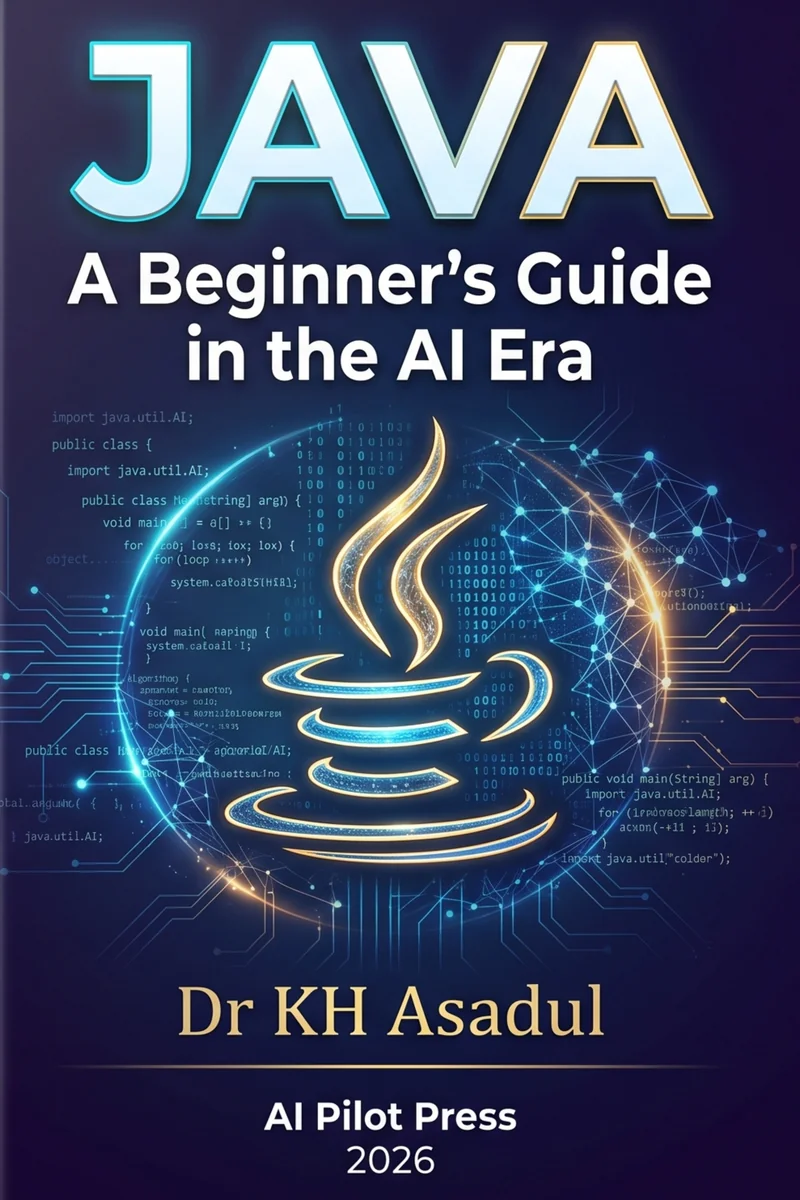
Java
A Beginner's Guide in the AI Era
Begin exploring Java with a guide written for learners in the AI era. Develop a foundation in the language and consider how to approach programming with an AI assistant as a partner.
View on Amazon ↗Opens Amazon in a new tab. Check the listing for formats and availability.
About this book.
Learn Java the way a good mentor would teach it — patiently, honestly, and with a powerful new tool in your hand: AI.
This isn't a book that hands you a chatbot and calls it a day. It's a complete, hands-on introduction to Java — variables, control flow, object-oriented programming, collections, streams, file handling, exceptions, and even a simple graphical app — built for absolute beginners, and built for right now, when every learner has an AI assistant available at 2 a.m.
Every chapter follows the same friendly, no-nonsense shape: a plain-language explanation before any syntax, a specific "AI Sidekick" prompt that teaches you how to use AI to deepen your understanding (not replace it), small practice exercises, a mini-challenge with a model solution, and a clear recap. Three progressively bigger projects — a command-line task manager, a library/inventory system, and a small JavaFX app — turn concepts into real, working software you build yourself.
By the end, you'll have written real Java programs, debugged real errors, read someone else's code with confidence, and built the single habit that matters most in the AI era: verifying what you build, instead of blindly trusting it. The book closes with a capstone project — a personal expense tracker you design and build mostly on your own — proof to yourself that you've genuinely got this.
No prior programming experience required. Just a computer, some patience, and a willingness to see an error message and try again.
Reader resources.
Includes a README with setup notes and a chapter-by-chapter file index.
Official documentation and guides for topics covered in this book.
← Back to the books